Tuesday, 21 March 2023

Gressenhall Workhouse

 I'll start with a brief, lifted, history of Gressenhall:

In 1776 the combined parishes of Mitford and Launditch bought Chapel Farm at Gressenhall to build a ‘house of industry’ for the poor. Conditions were tough, however, poor families were allowed to live together and earn some money from their work.

In 1834 the Poor Law Amendment Act led to the transformation of the house of industry into a workhouse – one of 22 Union Workhouses across Norfolk. The aim was to keep costs low by making life for the paupers so unpleasant that people would do everything they could to avoid having to live there. A new system of classification separated men, women and children. Work included breaking stones, pumping water, carting gravel and oakum picking for men and domestic chores in the kitchens, laundry and female wards for women. The only benefits were the health care and education.

The workhouse finally closed in 1948. After a short period of time as a home for the elderly, Gressenhall Farm and Workhouse opened as a museum in 1976.

The museum is effectively split in two parts. Part one relates to life in the workhouse which could be pretty grim. It was designed to keep the inmates alive, clean and healthy but food was basic in the extreme, days were regimented for all with lights out at 8pm, punishments for breaking rules and and pretty much nothing to look forward to. There was no obligation to stay but if your prospects outside were limited it often amounted to the best option available. 

There are various display illustrating life in the house with stories from inmates and those in charge and the old laundry, worked by female inmates, also still exists.


The second part of the museum relates to Norfolk life in days gone by with quite a lot of old farming machinery, a village shop, forge, post office and schoolroom amongst a number of interesting displays.

Sunday, 19 March 2023

Strangers' Hall, Norwich

I have been to Norwich many times over the years but the existence of this place has never really registered. Strangers' Hall is a museum of domestic history and is a Grade 1 listed building. Many additions to the building have been made over the years but it originates in the 14th century and has been home to many mayors of Norwich dating back to 1340. It is through one of the mayors that the name originates.

In 1565, due to a depression in the city's cloth industry, the then mayor invited experienced weavers and their families to Norwich to share their expertise. Many of these families came from Belgium, the Netherlands and Luxembourg and were known as the Strangers. The Strangers revived the fortunes of the Norwich cloth industry and the Stranger community grew quite rapidly, introducing printing, gardening and encouraging plant cultivation.

The hall had a number of owners over subsequent years but by the 1890's it was empty and derelict. However, in 1899 a local solicitor purchased the building, saving it from demolition, and turned it in to a folk museum which opened the following year. It has remained a museum ever since and is now owned by the Norfolk Museums Service.

We visited a few days ago and found it really interesting with lots of period furniture and info on the artefacts on display together with histories of the house over different periods. Here are a few pictures from the visit.


Tuesday, 14 March 2023

St Benet's Abbey, Norfolk

 St Benet's, on the River Bure, just outside of Ludham, was a medieval monastery built around the 10th century on the site of a previous monastery and added to over subsequent years. It was the only Norfolk monastery founded in the Anglo-Saxon period that continued in use throughout the middle ages.

Monasteries generally suffered under the dissolutions of Henry VIII but St Benet's was the only monastery that was not closed down. Instead it was united with the Bishopric of Norwich and to this day the Bishop of Norwich is the Abbot of St Benets and undertakes a service annually on the first Sunday of August.

However, despite this apparent reprieve the monks left anyway and the abbey was abandoned by 1545. The Abbey was dismantled and the church sold off stone as building materials.

In the second half of the 18th century a farmer built a windmill on the surviving 14th century gatehouse and although this resulted in the loss of the upper floor of the gatehouse the ruined windmill itself is now a grade II listed monument.


Possibly as a result of being inside, the stone arch of the gatehouse still features some fairly clear engravings of soldier figure and a dragon or griffon creature.
The surviving flint decorative panels suggest the gatehouse would have been a quite impressive looking structure.
Outside of the gatehouse very little of the abbey is still in eveidence save for some low level stone wall remains.
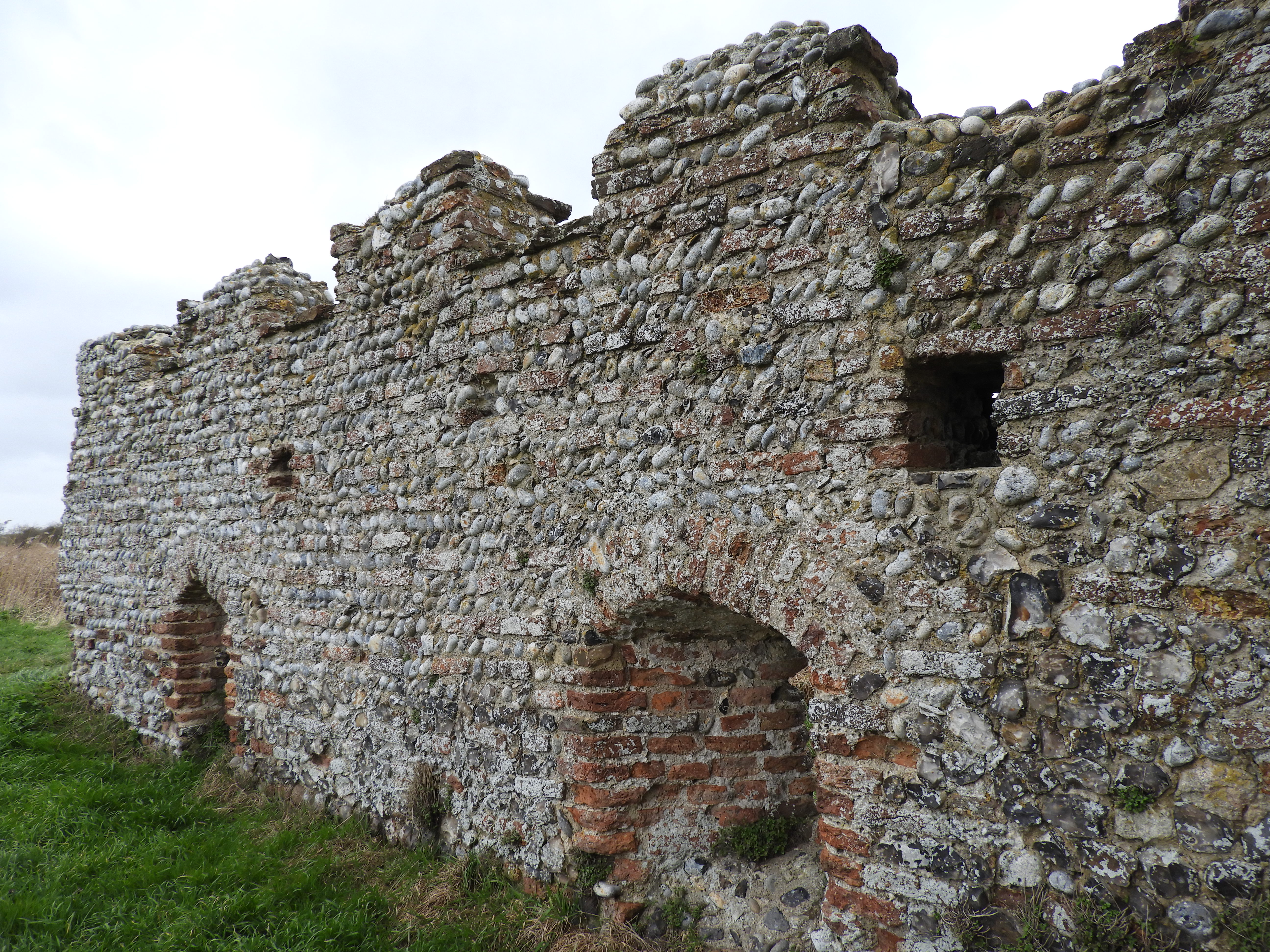
The whole monastery site was originally surrounded by a defensive type wall sections of which can still be seen.